I just returned home from Switzerland, and I have a confession: before this trip, I didn’t even realize Switzerland grew grapes. Chocolate, cheese, watches, mountains? Absolutely. Vineyards? Not on my radar.
There’s a good reason for that. Only about 1% of Swiss wine ever leaves the country. The Swiss make it, the Swiss love it, and the Swiss drink nearly all of it themselves.
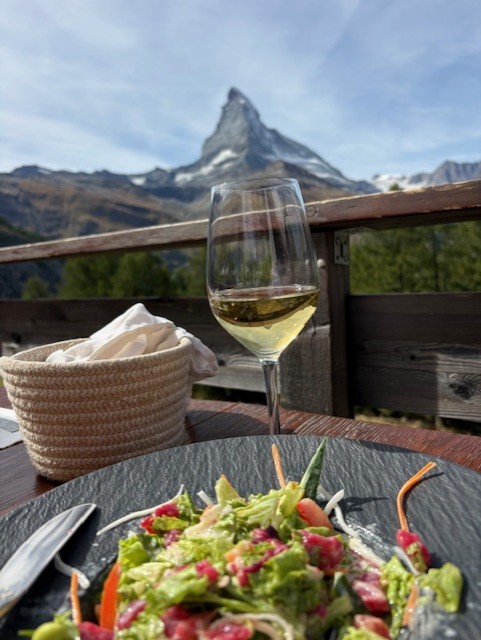
So for October’s Grape of the Month, I want to introduce you to the grape I fell head over heels for on my trip – Chasselas (pronounced cha-suh-luhs). It’s light, it’s crisp, and it was the perfect partner for a simple salad on a sunny afternoon. I’d also pair it with seafood, cheese, fondue, raclette and Après-ski. It’s a hidden gem, and I found it.
Meet Chasselas
Chasselas is Switzerland’s most widely planted white grape, with roughly 3,400 hectares planted throughout the country. You’ll find it primarily in Vaud, Valais, Geneva and the Three Lakes region, particularly around Neuchâtel.
Depending on where you are, however, you might not see “Chasselas” on the bottle.
In Valais, it’s called Fendant. In Germany, where the grape is also grown, you’ll see it called Gutedel.
And in Vaud, the Swiss take terroir so seriously that the label may emphasize the village or vineyard—names such as Dézaley, Yvorne or Féchy—rather than Chasselas itself.
Where Did Chasselas Come From?
For years, there were all kinds of theories about Chasselas. Some suggested that it originated in Egypt or Burgundy.
Modern genetic research has changed that story.
Today, Chasselas is considered to have originated in the Lake Geneva region, most likely in the canton of Vaud. DNA research helped dismiss those older theories of Egyptian or Burgundian origins.
One interesting point about the grape’s DNA: while genetic work has helped researchers establish its Swiss origins and relationships among many traditional Swiss varieties, Chasselas doesn’t have one of those neat, famous parentage stories we can tell about grapes such as Cabernet Sauvignon. Its exact parentage remains less clearly established.
Why Does Chasselas Love Switzerland?
Chasselas is an early-ripening, vigorous grape that can adapt to different soils and microclimates. More importantly, it has a wonderful ability to reflect where it’s grown.
And Switzerland gives it plenty to talk about.
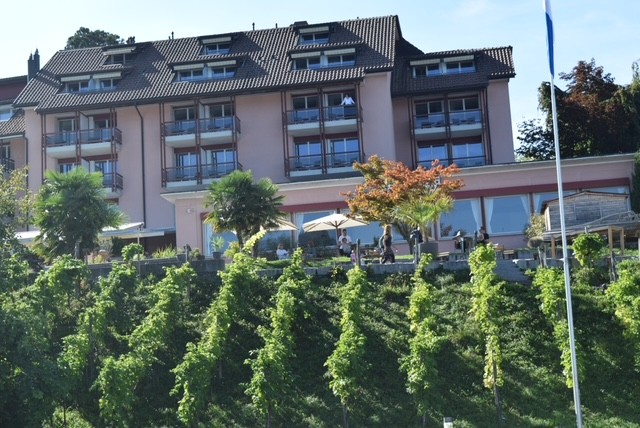
Think about the landscape: mountains, steep vineyard slopes, lakes, varying elevations and an incredible patchwork of soils and microclimates.
In Vaud, Lake Geneva helps moderate temperatures. In places such as Lavaux, vineyards climb dramatically above the lake on terraces, where vines benefit from sunlight and heat reflected from both the lake and the vineyard walls.
Head into Valais, and conditions change. The region is warm, dry and sunny, with dramatic differences between daytime and nighttime temperatures. The dry foehn winds also play a role in grape ripening and vineyard health.
That’s part of the beauty of Chasselas: it lets the vineyard do the talking.
What Does Chasselas Taste Like?
The Chasselas wines I tasted were exactly the kind of wines I love discovering when I travel: light, crisp, refreshing and incredibly easy to drink.
Typically, Chasselas is a dry, crisp, and light white wine with delicate aromas and flavors of apple, pear and citrus, often accompanied by white flowers and a distinctive mineral character. Acidity tends to be gentle rather than sharp or aggressive, but it’s there and lets you know.
Depending on where it’s grown, you can find everything from delicate floral expressions to wines with pronounced minerality and even flinty notes.
And don’t assume Chasselas is always meant to be drunk young. While most are enjoyed within a few years, better examples can age beautifully, developing notes of honey, hazelnut, beeswax and dried fruit.

What’s on the Table?
One afternoon in Switzerland, I enjoyed a Chasselas with my salad, and it was just perfect. The wine was light enough not to overwhelm the food, and its freshness made everything on the plate come alive. I also enjoyed it on the Glacier Express on the way to Zermatt.
What else would I pair with it?
Seafood would be wonderful—especially delicate white fish, shrimp, or simply prepared shellfish. I’d also reach for Chasselas with salads, light chicken dishes and, of course, cheese.
And we’re talking about Switzerland, so you know where this is heading.
Fondue. Raclette pair with Chasselas.
There’s a reason this combination works. The wine’s freshness and minerality provide a wonderful counterpoint to rich, creamy melted cheese. Chasselas is traditionally paired with fondue, raclette and Swiss lake fish such as perch and trout.
From Summer to Après-Ski
What I really love about Chasselas is that it doesn’t seem tied to one season.
I could happily drink a chilled glass on the patio in July with a salad or seafood.
But I can just as easily picture myself sitting somewhere in the Swiss Alps after a day in the snow, enjoying a glass of Chasselas with cheese.
Maybe that’s what makes this grape so appealing. It isn’t trying to be the biggest, boldest or most aromatic wine at the table. It’s subtle. It’s fresh. It’s mineral-driven. And it’s incredibly food-friendly and likes to have a good time.
I went to Switzerland not realizing how much wine was being produced there, and I came home wondering why we don’t see more of it.
Then I remembered: they’re keeping about 99% of it for themselves.
After tasting Chasselas, I can’t say I blame them.
So, if you ever see a bottle of Swiss Chasselas—or a bottle labeled Fendant—don’t walk past it because you don’t recognize the grape.
Pick it up.
Pour yourself a glass.